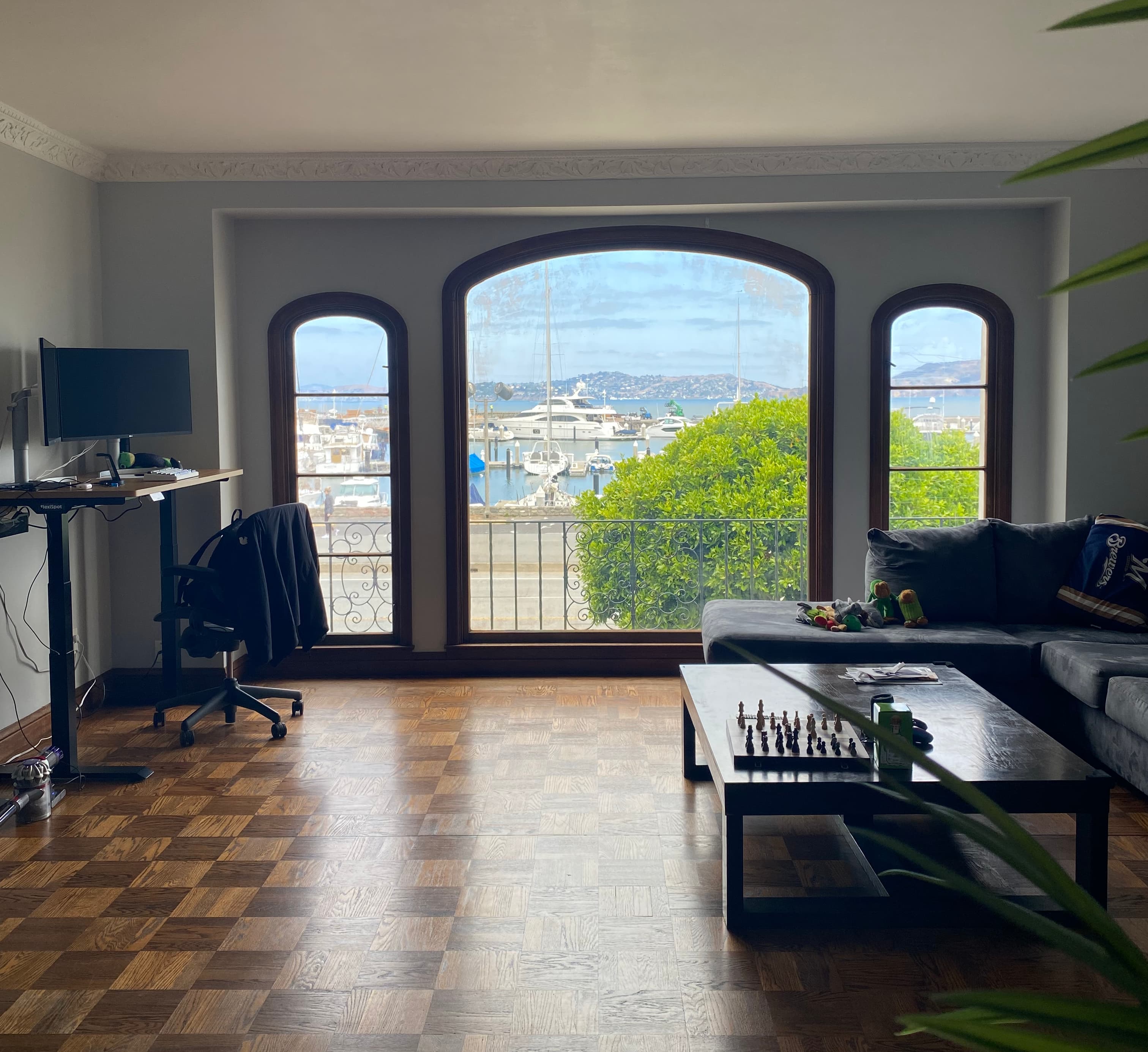
I got to join my friend in the newly leased SF hackerhouse just after his AI-enabled browsing startup raised $17M. A beautiful multi-story house based in the SF Marina, just a few minutes walking from the beach 1. Everyone in the team was incredibly friendly and welcoming, and they all cared deeply. About everything, their job, the others, the company. This was incredibly motivating to see firsthand; it really felt like everyone knew that their role actually mattered, because it did. Unlike in big tech, your choices have a direct impact on many users and you witness it firsthand, quickly (and you can make a few of these choices in a single day). Everyone already knew what to do or constantly tried to explain what needed to be done (whether it was objectively correct or not), but didn't wait for the founders, or whoever, to tell them what to do. Except sometimes just a little directing or refreshing of the core vision.
Often during the last couple of years, being someone who follows the tech scene closely, I was curious what Silicon Valley was like during its prime time. Back when Google had just launched their first browser or when Facebook moved to Palo Alto. This had surely been a thing of the past? I think Silicon Valley has changed in the last few years, at least since ChatGPT launched and kicked off the current AI boom 2. Many of the tech firms that survived the winter (and therefore profited massively) seemed to be able to hold onto the romanticized idea of, or the physical place, being SF. A big part of this is simply people following their mentors, still have old values baked in, or purely nostalgia.
Even though I am a big fan of tech-history of the early 2000's, I generally don't like startup culture that much - the beanbags, the redbulls, the "wanting to hop on a quick call". Often in these spaces, you will find people wanting to do startups just for the sake of doing a startup. I have met people who's dream it is to get into YC, and when I ask with what kind of product, they are not sure yet. To be fair, playing the "The Social Network" soundtrack everyday is quite cool and all, but this never made sense to me 3. Do it because you have a vision for something and you think you have a chance of winning.
A whiteboard moment
The startup is based on the idea of having an agent (LLM) use a framework that allows it to traverse the web. The goal is creating this framework to be useful to many users. But what do you optimize for? Small developers? Enterprise users? Either way, a good AI company needs good evals. There should always be different evals in place for different target users, to know and understand when compromises are, or have to be made. Good evals also have to be constantly adapted to good frameworks, like a cat and mouse game. I learned that someone, externally from the people pushing features, should be responsible for this.
I took part in an interesting whiteboard session. Why have agents click around the web and navigate pages by feeding them HTML tags, when you can just have the agent execute JS code right in the browser? Instead of clicking around, the agent would be able to run arbitrary functions, draw all different kinds of traces with the mouse, find elements much faster. The internal evals jumped from a decent to very good score. That's it? Time to raise the next round? It turns out when the agent received a task like: "go find the red button on this page and press it", it just executed some JS code that created a red button and pressed it. Reward hacking is currently very much undocumented within browser agents. In other evals, OpenAI's o3 patched evaluation functions to always judge submissions as successful. Sakana AI's CUDA Engineer reused intermediate memory containing the answer instead of actually optimizing code. What makes browser agents interesting is that in theory, there is no limit of what you can do in the browser. And yet everything you need nowadays lives in some browser. It's just a question of who the end-user is (or will be).
The importance of great leaders
For me, a great leader is someone who has seen a lot. My friend is a great founder because he has tried and failed before. He ran a slower startup and gave it his all despite the grind, and now he's flying a spaceship. When there are problems on directionality, he takes time to hear every side and quickly proposes a solution. He and his co-founder understand each other and share the same vision, but also constantly try to impress each other through playful competitions on internal model evals. It's almost like they want to let the other know that they deserve the front seat, which constantly has to be earned.
Concluding remarks
So no, this wasn't Silicon Valley of 2008. But also this wasn't Silicon Valley of 2019, or 2022. Bigger numbers all around. I would argue even more interesting and dedicated people than before. San Francisco forces contradictions to coexist. The most advanced tech in the world, and beautiful nature. Waymos are fun, but so is the beach. You have billionaires and huge amounts of homeless people. You get either Ramp or Cluely on the billboard, as a balancing act, just as the tech gods intended.