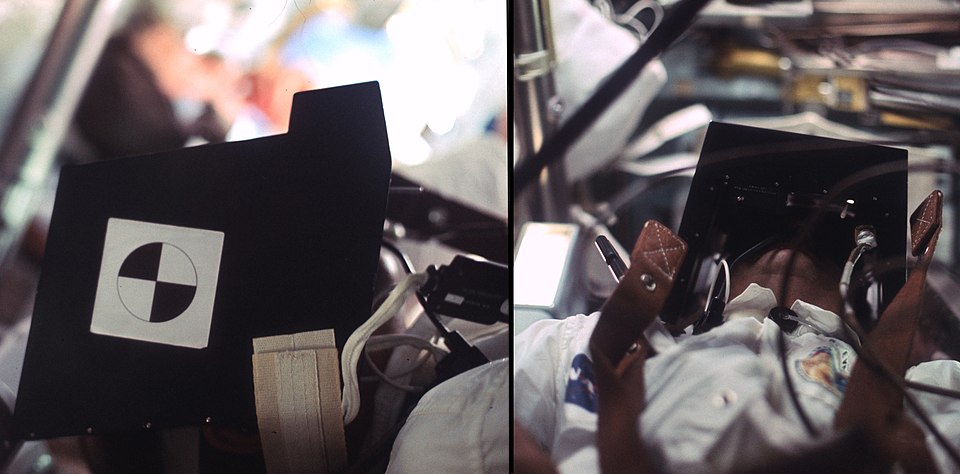
Apollo astronauts saw flashes of light with their eyes closed. About once every 2.9 minutes on average, in the dark, with no light source involved 1. The mechanism turned out to be cosmic ray particles ionizing molecules in the retina, or producing Cherenkov radiation in the vitreous humor, on their way through the head. The brain treated the resulting signal as light because at the receptor level it had no way to tell it wasn't.
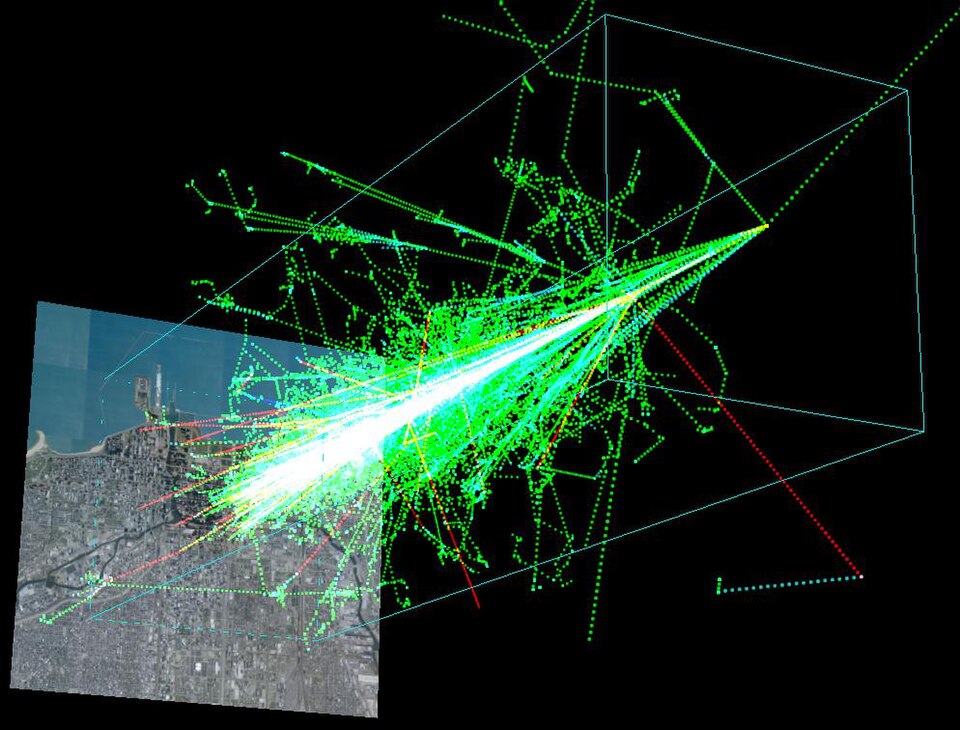
The same kind of ionization happens at sea level, just much less. About one muon per square centimeter per minute reaches the ground, which is roughly ten muons per second through a head-sized volume 2. That flux is going through everyone, continuously, and a small subset of those particles deposit enough energy somewhere sensitive to flip a bit of state.
In computers this is well documented. Ziegler and Lanford described the mechanism for cosmic-ray-induced bit flips in DRAM in 1979 3. Modern estimates put the rate at roughly one flip per 256 MB per month at sea level, scaling with altitude (about an order of magnitude higher on a mountaintop, about 300x on a plane) 4.
There is a well-documented case study of one of these in the wild, from a 2013 Super Mario 64 speedrun race. The runner DOTA_Teabag was running the 70-star category live on stream against another player, MidBoss, when his Mario teleported straight upward through a ceiling and ended up on the floor above 5. The warp saved time. More importantly, nothing in the game's state at that moment could have produced it. Pannenkoek2012, a SM64 analyst who has spent years documenting the engine's quirks, posted a $1,000 bounty for anyone who could reproduce the glitch in normal play. It went unclaimed for years.
The leading explanation is a cosmic ray bit flip in the N64's RAM. A single bit in the high byte of Mario's vertical position flipped from 1 to 0, changing the byte from 0xC5 to 0xC4 and his height in memory from 0xC5837800 to 0xC4837800, which by coincidence corresponded almost exactly to the height of the floor above him. Pannenkoek confirmed this was plausible by manually flipping that bit at the same moment in the run and reproducing the warp.
Neurons are very noisy components
If you record from a single cortical neuron and present the same stimulus 100 times, the responses are not identical. Spike timings vary by milliseconds, spike counts by tens of percent, membrane voltages fluctuate continuously at rest, and synaptic vesicle release is intrinsically stochastic. The standard reference is Faisal, Selen and Wolpert's 2008 review Noise in the nervous system 6, which argues that this kind of variability is unavoidable in any system built from molecular components at the nanometer scale. Their list of noise sources is almost entirely intracellular: thermal motion, ion channels, synaptic vesicles, biochemistry.
Evolution
A brain in a noiseless universe could afford to be deterministic, because nothing would ever flip its state from outside. A brain in our universe cannot, because something is always flipping its state from outside. Whether the dominant flips are cosmic, thermal, or biochemical is a quantitative question. The qualitative answer is the same: deterministic precision was never an option, and a brain architected for digital reliability would have been outcompeted long before it could do anything interesting.
So selection favored substrates that work despite ongoing corruption: distributed representations, population codes, soft thresholds, anything that prevents a single flipped bit from cascading into a wrong decision. The architecture is built to assume corruption is a constant of the environment, because in this environment it is.
Once noise tolerance is in place, evolution can repurpose the noise itself. The stochastic-dynamics literature in cognition makes this case directly 7: trial-to-trial variability prevents attractor networks from deadlocking, supports probabilistic inference, and enables stochastic resonance, where adding noise to a sub-threshold signal makes it detectable.
There is also some genuine error correction in the brain, just not at the level of individual cells. Sreenivasan and Fiete (2011) showed that grid cells in entorhinal cortex implement an analog error-correcting code for spatial position 8. The hexagonal firing pattern that initially looked like a computational quirk is a redundant population code with strong noise resistance. There is probably more of this hiding in cortex that hasn't been characterized yet.
Announcing my new company: Blips (Brain Flips). We launch satellites that beam collimated muons through the meeting room of your choice, flipping one or more bits somewhere in your counterparty's brain at the moment of decision. We are working on the targeting. We cannot tell you which bits. We cannot tell you which way they flip. Outcomes are stochastic in the technical sense. Accepting angel checks.
Footnotes
-
Cosmic ray visual phenomena - Wikipedia. The Apollo Light Flash Moving Emulsion Detector experiment on Apollo 16 and 17 confirmed the link by matching cosmic ray tracks to reported flashes. ↩
-
Muons - Lawrence Berkeley Laboratory. ~1 muon/cm²/min at sea level; about ten per second through a volume the size of a human head. ↩
-
Soft error - Wikipedia. Flux roughly doubles every 1,000 m of altitude. ↩
-
Cosmic Ray Flips Bit, Assists Mario 64 Speedrunner, Hackaday, 2021. Pannenkoek2012's original video on the bounty: SM64 - TTC Upwarp $1000 Bounty. ↩
-
Faisal, Selen & Wolpert, Noise in the nervous system, Nature Reviews Neuroscience, 2008. ↩
-
Deco & Rolls, Stochastic dynamics as a principle of brain function. For the noise-as-feature angle specifically, Stochastic resonance - Wikipedia. ↩
-
Sreenivasan & Fiete, Grid cells generate an analog error-correcting code for singularly precise neural computation, Nature Neuroscience, 2011. ↩

 . The opinions stated here are my own, not necessarily those of my employer.